

This section provides a curated collection of technical resources designed to support country governments, policymakers, and program implementers in scaling up Multiple Micronutrient Supplements (MMS) for pregnant women. These materials include policy guidance, implementation tools, evidence summaries, and financing strategies to help countries transition from iron–folic acid supplementation to MMS within antenatal care programs.
Resources are organized according to the four key pillars of MMS scale-up: Policy, Product, Delivery Systems and Financing. These resources are intended to assist stakeholders in planning, implementing, and sustaining effective MMS programs at national and subnational levels.
Four key pillars of MMS scale-up
Policy
Policy resources support governments in developing the regulatory, strategic, and programmatic frameworks required to introduce or scale MMS in national health and nutrition programs.
Resources
- Operational guidance on the use of MMS during (iron deficiency) anemia treatment in pregnancy.
- Guidance on MMS during breastfeeding. Also available in French and Portuguese.
- Technical brief “MMS during preconception”. Also available in French, Spanish and Portuguese.
- Technical brief “MMS in adolescents”. Also available in French, Spanish and Portuguese.
-
Further with 15
Over 130 million women will need MMS annually through 2030, with demand growing as countries scale it in antenatal care. Global partners and governments are working together to make MMS accessible. Further with 15 is a new narrative designed to equip advocates, donors, and policymakers with the tools and resources to take action for healthier pregnancies and brighter futures.
Explore -
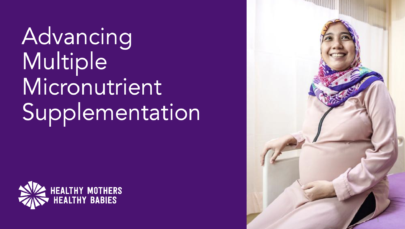
Adaptable MMS Advocacy Slide Deck
These slides are a resource for anyone wanting to communicate the evidence and benefits of multiple micronutrient supplementation (MMS) for pregnant women and their babies. They contain key messages that can be delivered to decision-makers or to those considering piloting, scaling, and implementing MMS. Available in multiple languages.
Explore -
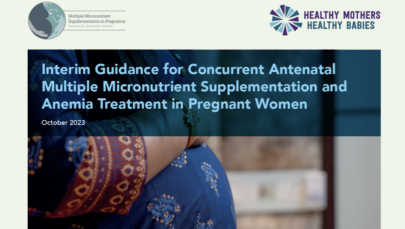
Interim guidance on anemia in pregnancy
This document provides guidance on the use of antenatal multiple micronutrient supplements (MMS) alongside the treatment of anemia in pregnant women. It is intended for national decision-makers, technical advisory groups, and program implementers who are considering or implementing programs to introduce MMS, especially the United Nations International Multiple Micronutrient Antenatal Preparation (UNIMMAP). This interim guidance is based on the expert opinion of the MMS Technical Advisory Group (TAG).
Explore
Product
Product resources focus on MMS formulation, manufacturing standards, quality assurance, and procurement guidance to ensure safe and effective products.
Resources
-
Child Nutrition Fund (UNICEF)
The CNF exists to reach 320 million children and women with high-impact nutrition actions annually by 2030.
Learn more -
Resources from Kirk Humanitarian
Explore the latest resources on UNIMMAP MMS research, policy guidance, manufacturing/supply, and advocacy.
Learn more
Delivery Systems
Delivery system resources support program implementers in integrating MMS into antenatal care services, supply chains, and community health platforms.
Resources
- Nutrition International (NI): Multiple micronutrient supplementation – Nutrition International.
- MMS training resources (NI): Introduction of Multiple Micronutrient Supplementation (MMS) through Antenatal Care (ANC): Training for Healthcare Providers – Nutrition International.
- Global Nutrition Programmes Monitoring (UNICEF): NutriDash | UNICEF.
- Implementation Science Guidance to Introduce and Scale MMS Programming. Also available in French, Portuguese, Arabic and Spanish.
- FAQ for National Decision-makers on the Introduction and Scaling-up of MMS. Also available in French, Portuguese, Arabic and Spanish.
Resources from Vitamin Angels
-
Healthy Pregnancy Starts Here: MMS Training Course. Also available in French and Spanish, accessible via the same link.
-
How to Distribute MMS to Pregnant Women: Job Aid for Service Providers. Also available in French and Spanish.
-
Healthy Pregnancy Starts Here (MMS Poster). Also available in Spanish.
-
Nurturing Healthy Mothers Poster. Also available in French, Spanish, Arabic, Haitian Creole, Tagalog and other languages.
-
Mobile App on MMS Basics. Also available in French, Spanish, Bahasa Indonesian, Arabic, Haitian Creole, and Tagalog.
Resources from Helen Keller Intl – Cambodia
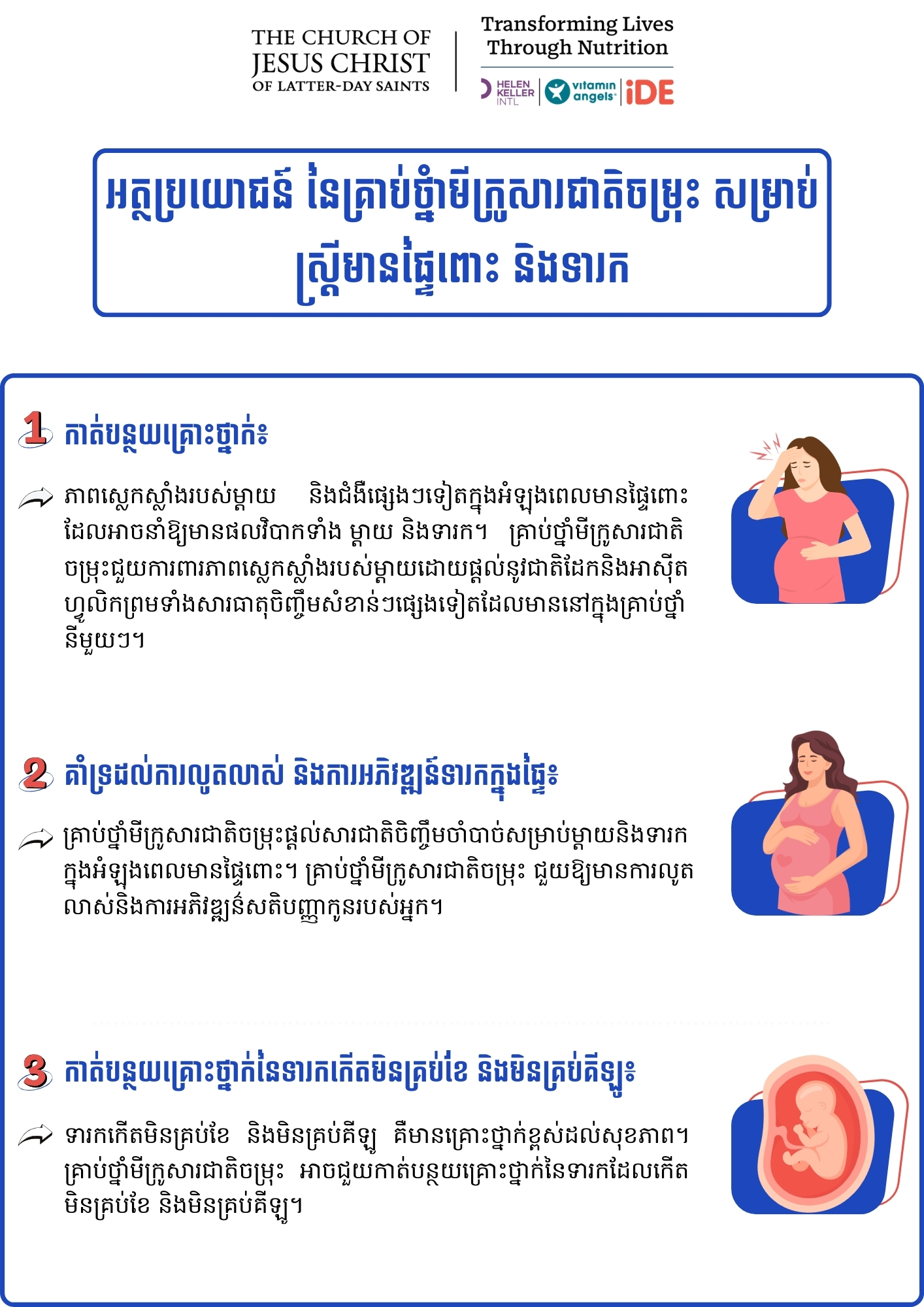
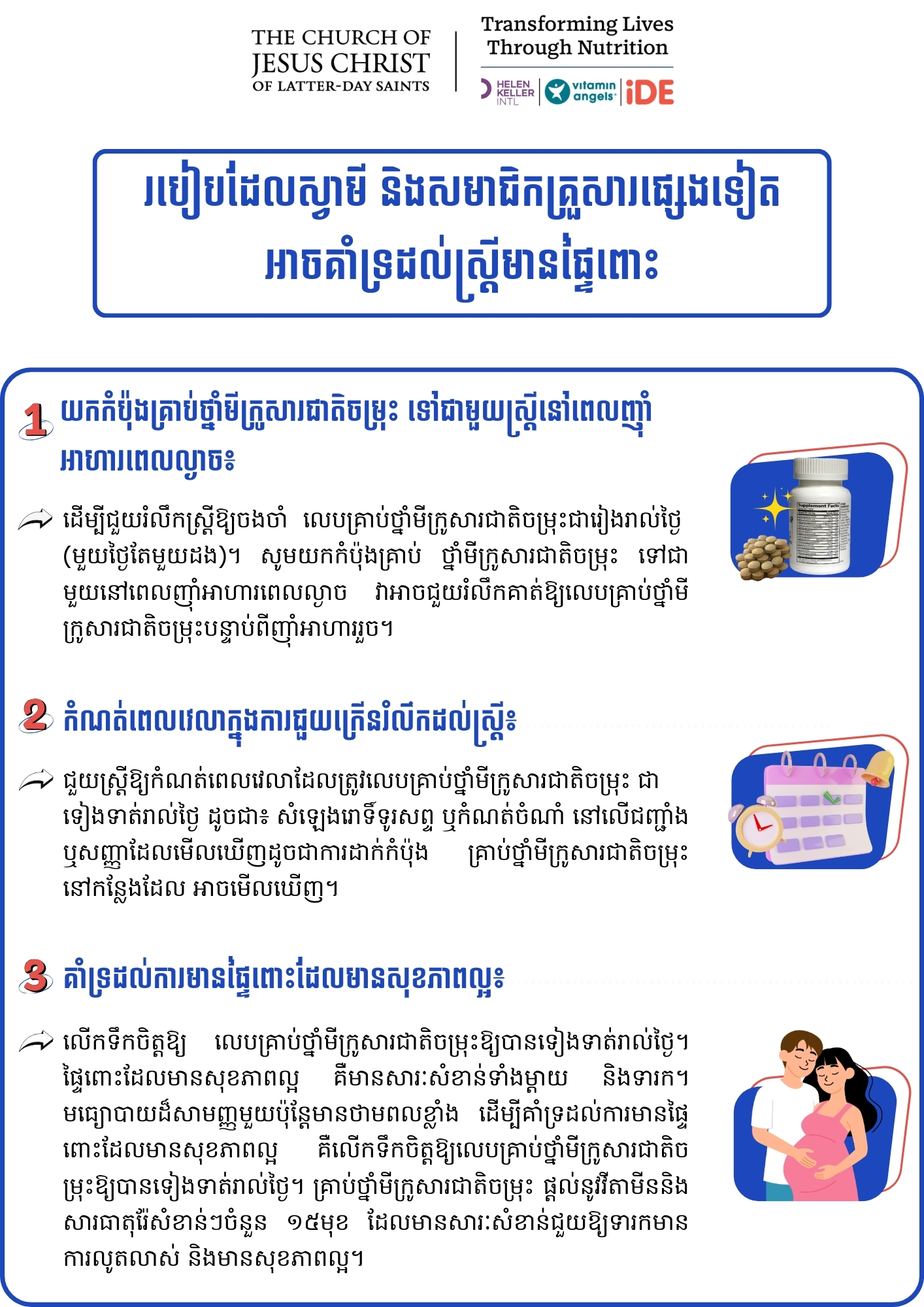
- Family Support Graphic 1 (Khmer)
- Family Support Graphic 2 (Khmer)
- Tracking Calendar (Khmer)
- MMS Brochure for family support (Khmer)
- MMS Label (Khmer)
- MMS Material for Research (Khmer)
- Focused Group Discussion Guides for influential family members, pregnant women and midwives (English)
- In-depth Interview Guides for MCH Chief, pregnant women, and supplement manufacturers (English)
- Market Observation Survey (English and Khmer)
- Monthly Pill Count/Weight Data Collection Sheet (English)
- SOP Quantitative Data Collection (English)
- MMS Acceptability and Adherence Survey (English)
Resources from Helen Keller Intl – Nepal
- MMS Calendar (Nepali)
- MMS Job Aid (Nepali)
- MMS Infographics Tool (Nepali)
- Poster IFA vs MMS (Nepali)
- Reminder Slip for Mother_blister_coral (Nepali)
- Reminder Slip for Mother_bottle_purple (Nepali)
- Reminder Slip for Mother_IFA_Blue (Nepali)
Financing
Financing resources help governments and partners identify sustainable funding pathways to support MMS procurement, program delivery, and long-term scale-up.
-
MMS Cost-benefit Tool
Nutrition International's tool calculates the incremental benefits and costs of transitioning from IFAS to MMS . It has data available for 32 countries and can be used to aid national decision-making.
Explore -
MMS Roadmap Costing Tool
Results for Development's (R4D) interactive, customizable roadmap costing tool helps implementing partners and governments develop costed MMS introduction and scale-up roadmaps.
Explore
Other Resources
- Compilation of country case studies, and resources (Sight and Life).
- HMHB Frequently Asked Questions (FAQ) on MMS.
- Landscape analysis guide and tools (Vitamin Angels)
- MMS Landscape Analysis – Nepal (Helen Keller Intl)
- MMS Brochure (Helen Keller Intl)