

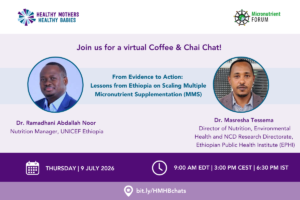
10 July 2026 – The Healthy Mothers Healthy Babies (HMHB) virtual Coffee & Chai Chat, held on 9 July 2026, brought together 215 researchers, policymakers, implementers, and development partners from around the world to explore Ethiopia’s journey from generating evidence on multiple micronutrient supplementation (MMS) to scaling the intervention through national policy and programming. The session, titled “From Evidence to Action: Lessons from Ethiopia on Scaling MMS,” featured Dr. Masresha Tessema of the Ethiopian Public Health Institute (EPHI) and Dr. Ramadhani Noor of UNICEF Ethiopia.
VIEW THE SLIDES: Masresha Tessema | Ramadhani Noor
Watch the Recording
Key Messages
- Ethiopia’s landmark MMS trial involving more than 85,000 pregnant women demonstrated that MMS improved birth outcomes compared with iron-folic acid (IFA) supplementation, increasing average birthweight by approximately 38 grams and reducing low birthweight by about 27%. Women who consumed at least 90 tablets experienced even greater benefits, with an average birthweight increase of about 58 grams.
- Adherence matters. The study showed a clear dose-response relationship, with higher adherence resulting in greater impact. At least 85% of women in the MMS arm adhered to supplementation for 90 days or more, compared with 53% in the IFA arm, highlighting the importance of early ANC attendance, counselling, and continuous access to supplements.
- MMS served as a catalyst for strengthening antenatal care services. Districts implementing MMS reported improvements in early ANC attendance, nutrition counselling, hemoglobin testing, follow-up visits, and overall utilization of maternal health services, demonstrating that MMS introduction can strengthen health systems beyond supplementation alone.
- Strong government leadership, local evidence, and multi-partner collaboration enabled Ethiopia to move rapidly from research to policy and implementation. Findings from the demonstration program informed national policy, implementation guidance, and a costed roadmap for nationwide MMS scale-up by 2030.
- Social and behaviour change interventions were critical to improving uptake and adherence. Ethiopia used community engagement, pregnant mothers’ groups, peer support mechanisms, and tailored behaviour-change strategies to address barriers to ANC attendance and consistent supplement use.
- Sustainable financing and local production are key priorities for the next phase of scale-up. Ethiopia has developed an investment case and financing strategy, while also exploring local manufacturing to reduce costs and support long-term sustainability.
- Ethiopia’s experience offers a practical model for other countries seeking to scale MMS. The key lesson is that successful scale-up requires more than an effective product—it depends on strong health systems, reliable supply chains, routine data systems, sustainable financing, and government ownership to translate evidence into impact at scale.
The Discussion
The discussion centered on findings from a landmark study recently published in The Lancet Global Health, one of the largest trials of its kind. The cluster-randomised trial included more than 85,000 women across five regions of Ethiopia and assessed the effectiveness of MMS compared with iron-folic acid (IFA) supplementation delivered through routine antenatal care (ANC) services in 42 districts of Ethiopia.
Presenting the study findings, co-author of the study, Dr. Tessema highlighted that MMS increased mean birthweight by 38 grams overall, and by 58 grams among women with high adherence (≥90 tablets), underscoring the critical importance of adherence in achieving impact. MMS also modestly reduced the risk of stillbirth, reinforcing global recommendations on MMS to improve maternal nutrition. Speakers emphasized that while MMS is a more effective intervention, maximizing benefits requires sustained use, early antenatal care attendance, and consistent access to supplements.
Beyond the clinical outcomes, the webinar demonstrated how MMS became an entry point for strengthening antenatal care (ANC) services in Ethiopia. Evidence presented during the session showed improvements in early ANC attendance, nutrition counselling, hemoglobin testing, follow-up care, and overall service utilization in districts implementing MMS. The speakers stressed that introducing MMS was not simply about replacing one supplement with another; it was also an opportunity to improve the quality and reach of maternal nutrition services within the health system.
Dr. Noor shared how Ethiopia moved rapidly from research to implementation by combining rigorous local evidence with behavior change strategies, implementation research, coordinated stakeholder engagement, and resource mobilization efforts. The country developed a financing strategy and investment case for MMS and is working with partners to secure long-term funding while strengthening existing supply chain and monitoring systems. Sustainability and local production of MMS emerged as important priorities for the next phase of implementation.
A key theme throughout the discussion was the role of government leadership, local evidence generation, and strong partnerships in accelerating policy change. Ethiopia used the findings from the demonstration program to inform policy recommendations, develop implementation guidance, and create a costed national roadmap for MMS scale-up through 2030. The country has already transitioned more than 100 districts from IFA to MMS and plans to continue expanding coverage through a phased approach.
Conclusion
Moderated by Dr. Martin Mwangi, HMHB Program Lead, the session concluded with reflections on Ethiopia’s broader contribution to global MMS scale-up efforts. Speakers noted that the country’s experience provides a practical framework for translating evidence into policy and then into large-scale implementation. As more countries consider transitioning from IFA to MMS, Ethiopia’s journey offers valuable lessons on leveraging routine health systems, strengthening ANC platforms, building sustainable financing mechanisms, and maintaining strong government ownership throughout the process.
The webinar reinforced a clear message: MMS has the potential to improve maternal and newborn outcomes, but successful scale-up depends on much more than the supplement itself. Strong health systems, reliable supply chains, behavior change programming, sustainable financing, routine data systems, and committed national leadership are all essential to translating evidence into impact at scale.