

What is Antenatal MMS?
Micronutrient deficiencies affect two out of three women of reproductive age worldwide [1] . Pregnancy increases the daily requirement of several vitamins and minerals to meet the nutritional needs of the developing fetus and other metabolic functions. Antenatal multiple micronutrient supplementation (MMS) is designed to address these heightened demands, which are often not met through diet alone. It is particularly beneficial for pregnant women in resource-poor settings where micronutrient intake is typically low due to poor dietary diversity, limited access to nutritious food, gender inequity, and prevalent social norms.
Forms of MMS
MMS is delivered in the form of a tablet, capsule, powder, or liquid that provides a combination of vitamins and minerals in the right amount. It is often accompanied by nutrition education and counseling to help ensure daily consumption.
The United Nations International Multiple Micronutrient Antenatal Preparation (UNIMMAP) MMS is an internationally accepted and standardized formulation that contains 15 essential vitamins and minerals, including iron and folic acid in recommended doses. In 2021, UNIMMAP MMS was included in the World Health Organization’s Model List of Essential Medicines based on evidence that it is effective and safe.
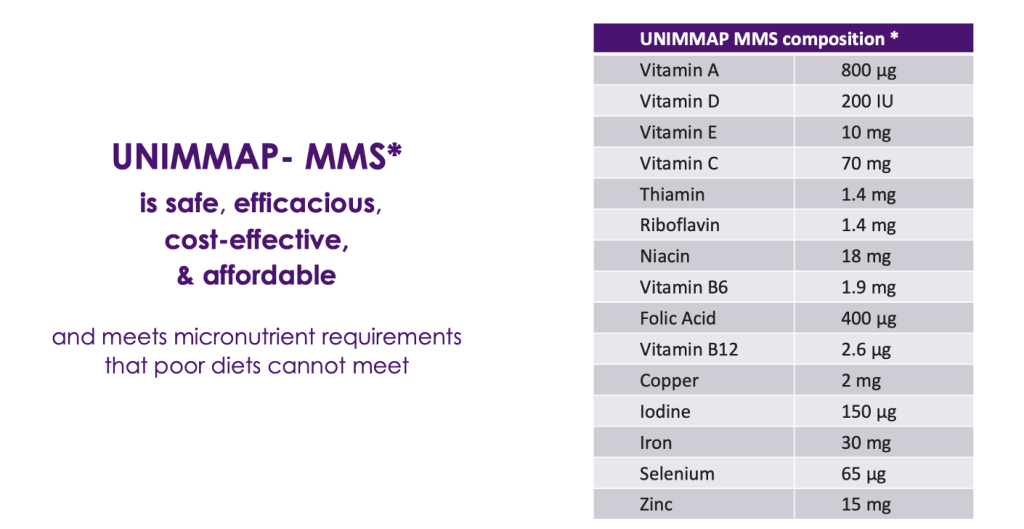
*United Nations International Multiple Micronutrient Antenatal Preparation – WHO, UNICEF, United Nations University. Composition of a multi-micronutrient supplement to be used in pilot programmes among pregnant women in developing countries.
The Multiple Micronutrient Supplementation (MMS) Technical Advisory Group (TAG) and the Micronutrient Forum (MNF) convened a technical consultation to develop an Expert Consensus on an Open-access UNIMMAP–MMS Product Specification for the manufacturing of this product in 2020. The 2024 revision of the Expert Consensus on an Open-Access UNIMMAP MMS Product Specification provides both purchasers and manufacturers with unified guidance on the production of UNIMMAP MMS. More specifically, it outlines the minimum requirements for manufacturing UNIMMAP MMS. It provides guidance on quality and regulatory standards based on whether the product is manufactured as a medicinal product or a dietary supplement. This publication also specifies labelling instructions for UNIMMAP MMS.
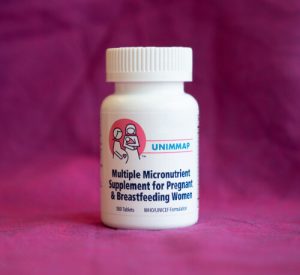
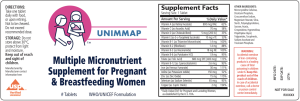
Label illustrating the minimum recommended information that should appear on the label of the UNIMMAP MMS.
What is the Evidence on the Benefits of MMS?
More than 20 years of research [2, 3] have provided clear evidence that MMS is efficacious, safe, cost-effective, and affordable.
MMS has been proven to improve maternal nutrition status [4, 5] and, in comparison with iron and folic acid supplements (IFAS), further reduce the risk of adverse birth outcomes such as preterm birth, stillbirth, low birth weight (LBW), and small-for-gestational-age (SGA) birth, [2, 3, 6] with additional benefits on infant growth up to six months of age. [7] Providing MMS to women during pregnancy can prevent long-lasting human capital losses in educational years and lifetime income [8].
Reduced Adverse Pregnancy Outcomes
Compared to IFAS alone, MMS can reduce the number of [2, 3, 6]
- infants born with low birthweight by 12-14%
- preterm births by 6 to 8%
- small-for-gestational-age newborn infants by 2 to 9%
- stillbirths by 8%.
In anemic or underweight pregnant women, the benefits of MMS over IFAS are even greater. For example, in anemic pregnant women, MMS reduces low birthweight by 19% and 6-month infant mortality by 29%.
MMS has also been proven to reduce the risk of giving birth to small, vulnerable newborns, particularly those with the greatest mortality risk [9].
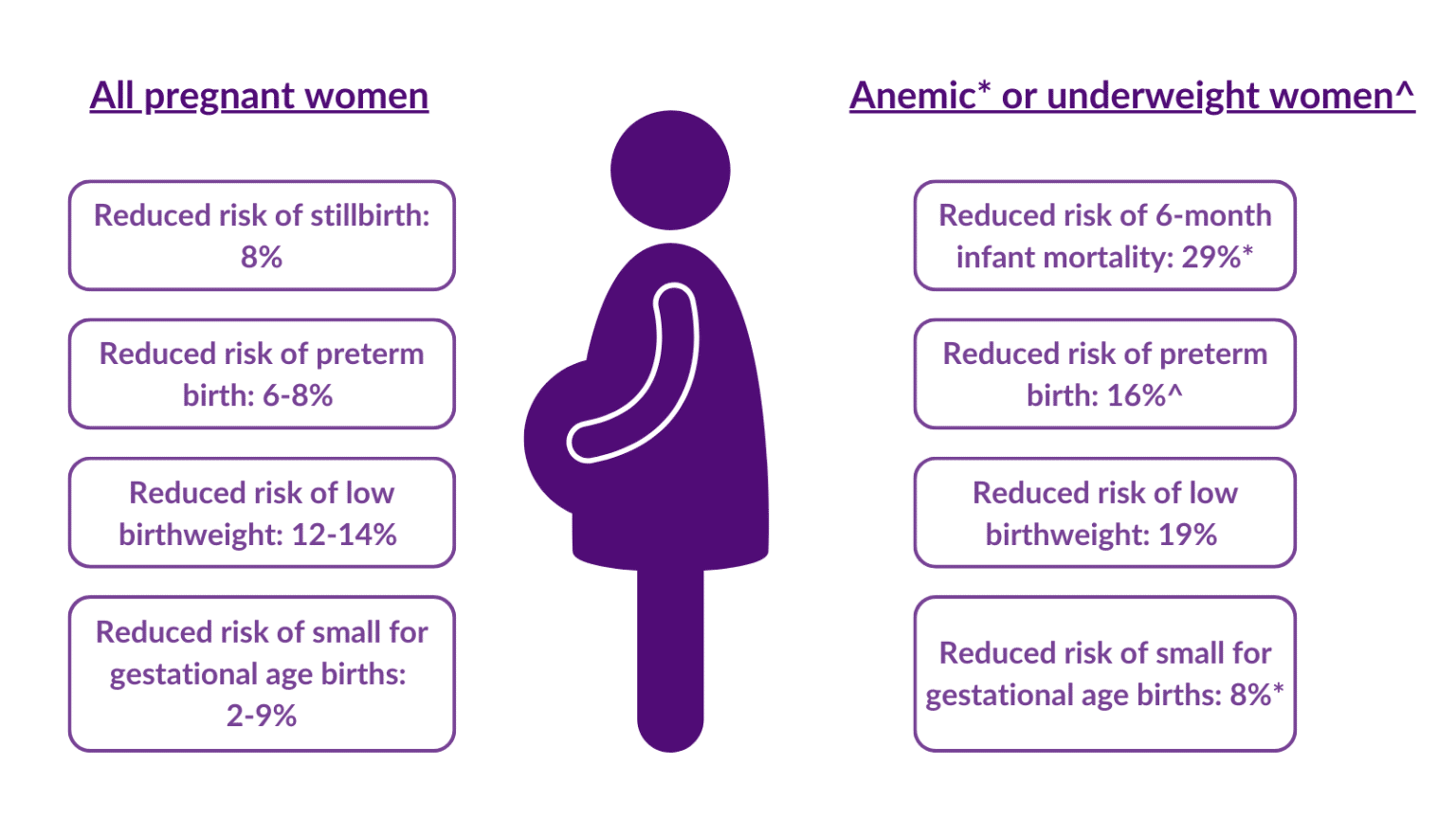
Summary of benefits of MMS vs. IFAS on pregnant women overall and in anemic (hemoglobin <110g/L) or underweight (BMI <18.5 kg/m2) pregnant women [2, 3, 6].
Improved Infant Size at Birth and Growth
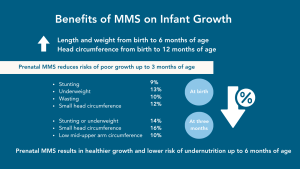
MMS also improves birth size and subsequent infant growth through 6-12 months of age. [7] Compared to antenatal IFAS, MMS results in greater infant:
- weight and length from birth to 6 months
- head circumference from birth to 12 months
- mid-upper arm circumference (MUAC) from birth to 3 months
MMS also reduces the risk of undernutrition in early infancy. From birth to 3 months of age, babies whose mothers take MMS have a lower risk of stunting (being too short for their age), being underweight (weighing too little for their age), having a small head circumference, and a low MUAC. In addition, MMS reduces the risk of wasting at birth (being too thin for their length).
MMS is Highly Cost-effective
Children born prematurely or with low birthweight (LBW) are less likely to go to school, develop reading and math skills, and earn higher wages in adulthood [10-12]. Studies show that using MMS instead of IFA can lead to better pregnancy outcomes and higher economic returns. The 2023 Copenhagen Consensus Report identifies MMS for pregnant women as one of the 12 best investments for global development. The report, authored by leading international economists, highlights the substantial economic benefits of MMS, resulting in a return of more than US$37 for every dollar spent [13].
Similarly, a recent analysis conducted by the MMS TAG also shows that transitioning from IFAS to MMS in 25 LMICs with the greatest burden of LBW would avert 3,514,594 LBW births, 186,369 stillbirths, and 218,914 female neonatal deaths, while generating large economic benefits ranging from $7.19 to $107.67 billion.
The total cost of replacing IFAS with MMS would be equivalent to between 0.5 and 3.0% of current spending on efforts to reduce undernutrition [14]. While there is a small incremental cost for MMS over IFA because of the additional micronutrients, a bottle of 180 tablets of UNIMMAP MMS costs as little as $ 2.50 per pregnancy [15].
-
MMS Cost-benefit Tool
Nutrition International's tool calculates the incremental benefits and costs of transitioning from IFAS to MMS . It has data available for 32 countries and can be used to aid national decision-making.
Explore -
MMS Roadmap Costing Tool
Results for Development's (R4D) interactive, customizable roadmap costing tool helps implementing partners and governments develop costed MMS introduction and scale-up roadmaps.
Explore
Technical Guidance
-
WHO Model List of Essential Medicines 2021
The World Health Organization included MMS in its 22nd Model List of Essential Medicines in 2021 following a joint evidence-based submission by the Micronutrient Forum and the New York Academy of Sciences.
Read -
WHO antenatal care recommendations for a positive pregnancy experience – Nutritional interventions update: Multiple micronutrient supplements during pregnancy. (WHO, 2020).
This guidance provides information on the context of MMS implementation.
Read -
Nutritional care and support for patients with tuberculosis (WHO, 2013).
This guideline provides guidance on the principles and evidence-informed recommendations on the nutritional care and support for patients with tuberculosis.
Read -
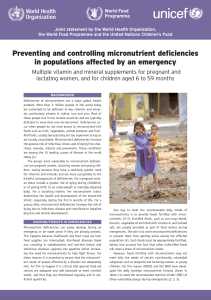
Preventing and controlling micronutrient deficiencies in populations affected by an emergency – Multiple vitamin and mineral supplements for pregnant and lactating women, and for children aged 6 to 59 months (WHO, WFP, UNICEF, 2006).
This guidance note recommends the use of MMS in an emergency context, when access to nutritious foods is interrupted, and fortified food rations cannot meet the needs of nutritionally vulnerable subgroups.
Read -
Programme Guidance on Maternal Nutrition: Prevention of malnutrition in women before and during pregnancy and while breastfeeding. (UNICEF, 2021).
This guidance aims to provide UNICEF country teams and their partners with guidance to design, implement, and monitor evidence-based programmes, including MMS, to improve the nutrition of women across the life course.
Read -
Programme Guidance to Protect the Nutrition of Women and Adolescent Girls in Humanitarian Settings (UNICEF, 2024).
This guidance was created for nutrition cluster/sectors, programme staff of UNICEF and the World Food Programme, and other practitioners who are designing and/or implementing a nutrition response in humanitarian settings.MMS are recommended for all pregnant and breastfeeding women and adolescent girls in humanitarian contexts.
Read
-
- Stevens GA, Beal T, Mbuya MNN, Luo H, Neufeld LM; Global Micronutrient Deficiencies Research Group. Micronutrient deficiencies among preschool-aged children and women of reproductive age worldwide: a pooled analysis of individual-level data from population-representative surveys. Lancet Glob Health. 2022 Nov;10(11):e1590-e1599. doi: 10.1016/S2214-109X(22)00367-9
- Keats, E. C. et al. Multiple‐micronutrient Supplementation for Women during Pregnancy. Cochrane Database Syst. Rev. 2019, 3 https://doi.org/10.1002/14651858.CD004905.pub6.
- Smith, E. R.et al. Modifiers of the Effect of Maternal Multiple Micronutrient Supplementation on Stillbirth, Birth Outcomes, and Infant Mortality: A Meta-Analysis of Individual Patient Data from 17 Randomised Trials in Low-Income and Middle-Income Countries. Lancet Glob. Heal. 2017, 5 (11). https://pubmed.ncbi.nlm.nih.gov/29025632/.
- Christian P, Jiang T, Khatry SK, LeClerq SC, Shrestha SR, West KPJ. Antenatal supplementation with micronutrients and biochemical indicators of status and subclinical infection in rural Nepal. Am J Clin Nutr. 2006;83(4):788-794. doi:10.1093/ajcn/83.4.788
- Schulze KJ, Mehra S, Shaikh S, et al. Antenatal Multiple Micronutrient Supplementation Compared to Iron–Folic Acid Affects Micronutrient Status but Does Not Eliminate Deficiencies in a Randomized Controlled Trial among Pregnant Women of Rural Bangladesh. J Nutr. 2019;149(7):1260-1270.
- World Health Organization. WHO Antenatal Care Recommendations for a Positive Pregnancy Experience. Nutritional Interventions Update: Multiple Micronutrient Supplements during Pregnancy.; 2020. https://www.who.int/publications/i/item/9789240007789.
- Gomes F, Adu-Afarwuah S, Agustina R, et al. Effect of prenatal multiple micronutrient supplementation compared with iron and folic acid supplementation on size at birth and subsequent growth through 24 mo of age: a systematic review and meta-analysis. The American Journal of Clinical Nutrition. Published online April 2025. doi:https://doi.org/10.1016/j.ajcnut.2025.04.022
- Perumal, N. et al. Impact of scaling up prenatal nutrition interventions on human capital outcomes in low- and middle-income countries: a modeling analysis. Am J Clin Nutr. 2021 Nov 8;114(5):1708-1718. doi: 10.1093/ajcn/nqab234. Erratum in: Am J Clin Nutr. 2022 Dec 19;116(6):1904. PMID: 34320177; PMCID: PMC8574629.
- Wang D, Liu E, Perumal N, Partap U, Cliffer IR, Costa JC, et al. The effects of prenatal multiple micronutrient supplementation and small-quantity lipid-based nutrient supplementation on small vulnerable newborn types in low-income and middle-income countries: a meta-analysis of individual participant data. Lancet Glob Health 2025;13:e298–308. https://doi.org/10.1016/S2214-109X(24)00449-2.
- Bilgin A, Mendonca M, Wolke D. Preterm birth/low birth weight and markers reflective of wealth in adulthood: a meta-analysis. Pediatrics. 2018 Jul;142(1):e20173625. doi: 10.1542/peds.2017-3625.
- Kormos CE, Wilkinson AJ, Davey CJ, Cunningham AJ. Low birth weight and intelligence in adolescence and early adulthood: a meta-analysis. J Public Health (Oxf). 2014 Jun;36(2):213-24. doi: 10.1093/pubmed/fdt071.
- McBryde M, Fitzallen GC, Liley HG, Taylor HG, Bora S. Academic outcomes of school-aged children born preterm: a systematic review and meta-analysis. JAMA Netw Open. 2020 Apr 1;3(4):e202027. doi: 10.1001/jamanetworkopen.2020.2027
- Larsen B, Hoddinott J, Razvi S. Investing in nutrition – a global best investment case. Journal of Benefit Cost Analysis. 2023 (in press). Available at: https://copenhagenconsensus.com/sites/default/files/2023-03/Nutrition%20Best%20Investment%20Manuscript%20230211.pdf
- Hoddinott J, Ajello C, Black RE, Busch-Hallen J, Mwangi M, Walters D, Gomes F. Costs and benefits of replacing preventive antenatal iron and folic acid with multiple micronutrients in 25 low- and middle-income countries. BMJ Global Health. (manuscript submitted for publication)
- Micronutrients tabs, pregnancy/BOT-180. Unicef.org. Published 2016. Accessed July 1, 2025. https://supply.unicef.org/s0000267.html