

Health Indicators
Programs
Download PDFSummary: Phase 3. Scale-up delivery at the national or sub-national level
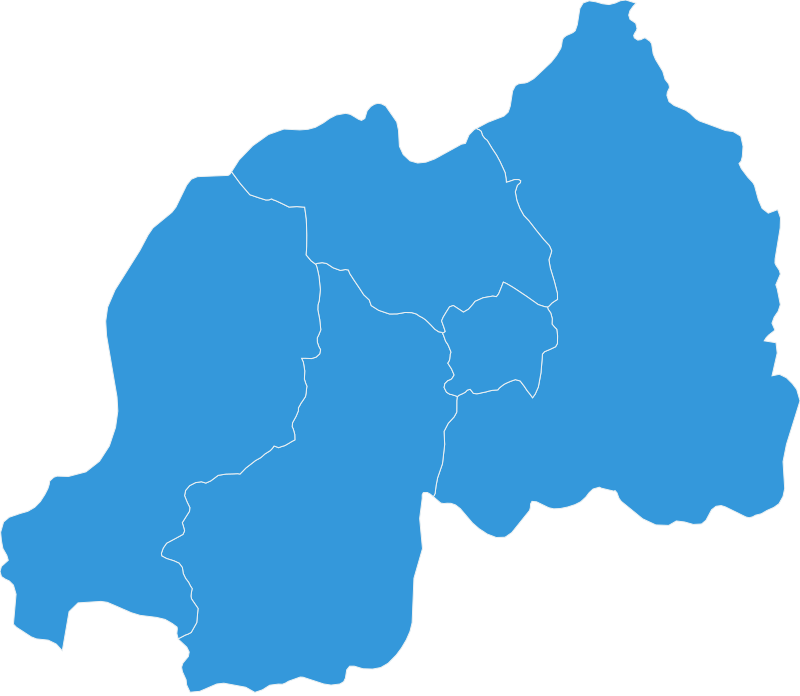
Rwanda is currently in Phase III of Multiple Micronutrient Supplementation (MMS) implementation and scale-up, with strong integration into national health systems. MMS has been incorporated into maternal nutrition guidelines, ANC guidelines, Essential Medicine List (EML), and other key national policies and strategic documents. A costed national MMS roadmap was developed and endorsed by the leadership, and an established national Technical Advisory Group (TAG) guided the process. Implementation research was conducted with the Rwanda Biomedical Centre (RBC), Sight and Life, and UNICEF to assess MMS coverage, adherence, and acceptability among women and ANC professionals in seven pilot districts.
The assessment revealed that 100% of 3,257 surveyed women who attended ANC services in the seven pilot districts received MMS during their current or last pregnancy. About 80% of those women reported that they consumed MMS every day in the previous seven days, which was consistent with those who reported that they consumed MMS in their last 30 days. 95% of women reported liking the supplements, 97% expressed motivation, 98% expressed confidence, and 98% expressed satisfaction with supplement consumption. Pregnant women consistently consumed MMS, mainly driven by a strong motivation and awareness of the benefits (both short- and long-term) for their own health and that of their babies, as well as an understanding of the supplement’s importance. Smell, taste, color, and packaging increased the acceptability of MMS tablets. The survey showed that family members and healthcare providers had a critical role in improving adherence to MMS, with reminders, motivation, and awareness. Barriers such as limited quality and depth in counseling, financial constraints of pregnant women and their families, and limited access to the services should be addressed to increase adherence to MMS in Rwanda.
After a successful pilot phase in seven districts in 2024, multiple micronutrient supplements have been scaled up in all districts in 2025, starting with scale-up in ten districts in May 2025 and thirteen districts in June 2025. To ensure effective transition and scale-up of MMS in Rwanda, the Rwanda MMS roadmap was developed to explore government contribution and co-financing to ensure sustainability.The Government of Rwanda is in the process of initiating the CNF matching program for the implementation of the program and MMS procurement. Delivery systems have been strengthened through capacity building for healthcare providers and the integration of MMS into Logistics Management Information Systems (LMIS). A social and behavior change communication (SBCC) strategy was developed with a focus on community engagement to improve uptake, and it is under the implementation phase.
Despite this progress, challenges remain. These include limited depth in counseling, incomplete ANC documentation, stock outs in some health facilities, and the absence of structured community outreach programs. Lessons learned emphasize the importance of effective counseling and strong partnerships for successful implementation.
Key stakeholders involved in the MMS initiative include the Catholic Medical Mission Board Foundation, CHAI, CIFF Africa, CRI Foundation, ECF, the Gates Foundation , Kirk Humanitarian, Ministry of Health, National Child Development Agency (NCDA), the Rwanda Biomedical Centre (RBC), Sight and Life Foundation, UNICEF, the University of Rwanda, and WHO.
Rwanda’s next steps include finalizing the CNF agreement to ensure program sustainability, implementing the activities outlined in the national roadmap, conducting comprehensive monitoring and evaluation from supply through consumption, and strengthening the monitoring and evaluation of SBCC activities.
Sources: HMHB Survey 2025, 2nd Africa Regional Meeting Report
Dashboard
Policy and Regulatory Status
Implementation Status
Coverage and Utilization
Key Program Actors and Partners
Supply Chain
Monitoring Evaluation and Research
Financing and Sustainability
Challenges and Next Steps
Tools and Resources
Summary: Phase 4. Sustained scale-up & integration
Rwanda has been implementing BEP supplementation nationally for several years with government support. The program, known as “Vision and Uwenge,” is guided by national maternal nutrition and antenatal care guidelines under the national family and nutrition policy framework. The BEP product is a fortified cereal/flour such as CSB+, locally known as “Shisha-Kibondo.” The product is produced by the local company Africa Improved Foods and certified by WFP. The company manages the storage and distribution of the product to antenatal care facilities across the country. Pregnant and lactating women qualify for the intervention if they have a MUAC < 21 cm and are low-income beneficiaries of the governmental social protection program. Women receive BEP supplementation until they achieve adequate weight gain during pregnancy. The intervention is delivered at antental care facilities, where mid-to-senior level health professionals provide the product to pregnant and lactating women. .
Sources: Kissel et al. (2026), CGIAR, WFP