

24 March 2026 – At the International Maternal and Newborn Health Conference 2026 in Nairobi, global experts and country leaders convened for a breakfast session titled “Strengthening Maternal and Newborn Health: Insights and Strategies from MMS Implementation,” exploring practical strategies to strengthen maternal and newborn health through multiple micronutrient supplementation (MMS). The breakfast session took place on 24 March 2026 from 7:00–8:30 AM in Boardroom 4 at The Edge Convention Centre.
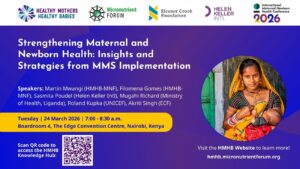
Hosted by the Micronutrient Forum through its Healthy Mothers Healthy Babies Consortium, and supported by the Eleanor Crook Foundation and Helen Keller Intl, the session highlighted the latest global evidence and practical lessons from country-led implementation experiences in Nepal and Uganda, including financing pathways for scale-up, such as the Child Nutrition Fund, in addition to domestic resource mobilization.
PC: Hadynyah/Getty Images
Session Highlights
Photos
Key Messages
The message was clear: the time to scale multiple micronutrient supplementation (MMS) is now.
Grounded in global implementation experiences, the session reinforced:
- Evidence: MMS is effective, cost-effective, highly acceptable and improves birth outcomes beyond iron–folic acid, including reductions in low birth weight and preterm birth
- Research to inform policy: Countries like Nepal are using implementation research, designed with policymakers, to answer critical questions and guide national decisions
- Roadmaps for transition: Uganda’s experience shows that costed roadmaps are essential for coordinated, smooth transition and integration into existing antenatal care systems
- Financing for scale: Mechanisms like the Child Nutrition Fund can unlock critical resources in addition to domestic resource mobilization and accelerate early adoption
- Systems strengthening: MMS is not a standalone intervention. It strengthens antenatal care and broader health and nutrition services
- Resources for action: Partners are equipping countries with guidance, tools, and a growing knowledge base to support every stage of the journey. HMHB’s Knowledge Hub hosts these resources in multiple languages
With 40+ countries already piloting or scaling MMS, momentum is real but must now translate into deliberate, country-led action.
PC: Crimson Communications
Speakers and Topics
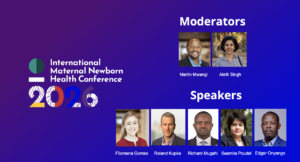
Moderated by: Dr Martin Mwangi, HMHB, Micronutrient Forum and Dr Akriti Singh, Eleanor Crook Foundation
Dr Filomena Gomes, HMHB, Micronutrient Forum – Global Evidence on MMS
- Small and vulnerable newborns (preterm, low birth weight, small-for-gestational-age) affect nearly 1 in 4 babies globally and account for over 50% of neonatal deaths.
- MMS is one of eight proven interventions that can substantially reduce adverse newborn outcomes.
- Pregnancy significantly increases the need for multiple micronutrients, many by up to 50%, which IFA alone cannot address.
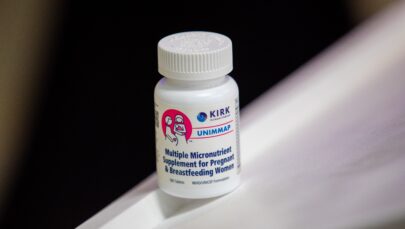
- The UNIMMAP MMS formulation provides 15 essential micronutrients, compared to only iron and folic acid in IFA.
- There is strong evidence on the health benefits of MMS from individual participant data meta-analyses and Cochrane reviews
- MMS reduces low birth weight, preterm births, small-for-gestational-age (SGA) births and infant mortality (with larger benefits among adolescent mothers)
- MMS is safe, widely acceptable and highly cost-effective, offering a return of $37 for every $1 invested.
- Countries are at different phases of MMS implementation, from exploration to national scale-up.
Dr Roland Kupla, UNICEF – Financing Mechanisms through the Child Nutrition Fund (CNF)
- The Child Nutrition Fund (CNF) is a UNICEF-led financing mechanism to support high-impact nutrition interventions in high-burden countries.
- CNF focuses on maternal nutrition (including MMS), breastfeeding and complementary feeding, micronutrient supplementation and treatment of child wasting
- Currently, the CNF supports 63 eligible high-burden countries, of which 43 are already receiving support.
- The key financing instruments are:
- Match Window: Matches government investment 1:1 for nutrition commodities (e.g., MMS)
- Program Window: Provides parallel or grant financing to support program rollout (“software”)
- Supplier Window: Supports supply availability and reduced delivery time
- Major donor support (e.g., Kirk Humanitarian) is enabling tens of millions of pregnant women to access MMS.
- CNF aims to crowd in domestic financing, not replace it, supporting sustainable scale-up.
COUNTRY EXPERIENCES
Dr Sasmita Poudel, Helen Keller Intl. – Nepal’s Experience
- Nepal transitioned from IFA to MMS by asking not whether MMS works, but whether it could be integrated effectively into national systems.
- The approach was multifaceted and parallel, focusing on policy reform, research, regulatory processes and supply readiness.
- Thanks to strong government leadership from the beginning, MMS is now included in the National Essential Medicines List.
- Nepal conducted extensive implementation research, including large randomized controlled trials, demonstration studies across provinces and qualitative studies with women, families, and providers.
- Findings showed no difference in adherence between MMS and IFA, no negative impact on ANC attendance and that MMS was operationally feasible within existing systems
- Nepal developed a 5‑year phased scale-up roadmap (starting 2026), with a gradual transition to government financing.
- Success was driven by early stakeholder engagement and the simultaneous alignment of evidence with policy.
Cynthia Nyaberi (on behalf of Dr Richard Mugahi, Ministry of Health, Uganda) – Uganda’s Experience
- Uganda needed a costed introduction roadmap due to fragmented MMS efforts by multiple partners.
- The roadmap helped create a shared national vision and coordinated scale-up plan.
- Uganda prioritized regions using a weighted burden analysis (anemia, low birth weight, preterm birth, and stillbirths).
- The scale-up plan aims for 20% national coverage per year, with full national coverage by 2030
- Strong leadership from the Ministry of Health, and early and continuous cross-departmental coordination and integration into existing ANC services, national supply chain and Health Management Information Systems have contributed to successful MMS adoption.
- MMS is now included in the Essential Medicines and Supplies List and integrated into national guidelines and training packages
- Early implementation in Uganda shows greater demand and acceptance by mothers compared IFA.
Edgar Okoth Onyango, SUN CSA, Kenya – Kenya’s Experience
- Kenya established a national MMS task force to align stakeholders and address divergent views.
- They developed a costed national roadmap, critical for county-level decision-making in Kenya’s devolved system.
- There was a clear division of roles, where the National government focused on policy and standards and county governments on financing and implementation.
- MMS has now been introduced in multiple counties, national protocols and implementation strategies have been developed and structured training packages created.
- Kenya is advancing three processes simultaneously: implementation and scale-up, policy integration and capacity building.
- MMS is registered nationally and will leverage existing IFA supply chains, avoiding parallel systems.
Conclusion
This session demonstrated that MMS is no longer an evidence question, but an implementation imperative. Through global evidence, country experiences from Nepal, Uganda, and Kenya, and the introduction of the Child Nutrition Fund, the session showed how countries can move from pilot efforts to nationally owned, financially sustainable scale-up. The most successful pathways combine strong government leadership, evidence-informed policy reform, realistic costing, and aligned financing mechanisms. With proven tools, shared learning, and coordinated investment, MMS can be scaled globally to significantly improve maternal and newborn outcomes.