

Health Indicators
Programs
Download PDFSummary: Phase 3. Scale-up delivery at the national or sub-national level
On 17 October 2024, the Ministry of Health of Indonesia, with support from Vitamin Angels, Kirk Humanitarian and UNICEF Indonesia, officially launched a national policy introducing multiple micronutrient supplementation (MMS) to replace iron-folic acid (IFA) for pregnant women. The MMS program aims to support healthier pregnancies and implementation has been initiated in 209 districts and cities across 15 provinces.
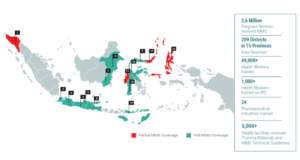
Since its launch in October 2024 through December 2025, the Ministry of Health, supported by Vitamin Angels and Kirk Humanitarian, has distributed a total of 2.6 million bottles of MMS (180 tablets per bottle) to pregnant women in 209 districts. The program has trained 50,000 health workers, distributed training materials and technical guidelines to more than 5,000 health centers, and trained 24 local pharmaceutical companies on open-access UNIMMAP MMS product specification.
The program is backed by implementation research from leading universities, including the University of Indonesia, Airlangga University, Hasanuddin University, Padjajaran University, and Johns Hopkins Bloomberg School of Public Health, which was initiated in 2020 by the Directorate of Nutrition within the Ministry of Health, coordinated by a locally formed the Indonesian MMS Technical Advisory Group (MMS-TAG) hosted by the Indonesia Nutrition Initiatives (MMS-TAG), and funded by Kirk Humanitarian and Vitamin Angels.
Based on the request from the Ministry of Health, Vitamin Angels and Kirk Humanitarian supported a supply context assessment that was carried out by PHARCI Padjadjaran University in 2021-22 to identify and facilitate the long-term local supply of UNIMMAP MMS. The key activities in this effort included conducting a supply context assessment that included cost-benefit and budget impact analyses as well as in-depth interviews with key supply stakeholders. Key issues and barriers identified included the need for national policy and regulations, manufacturing and marketplace, and procurement.
Sources: HMHB Survey 2021-2023, HMHB Survey 2025, Ministry of Health, Indonesia (2025 data)
Dashboard
Policy and Regulatory Status
Implementation Status
Key Program Actors and Partners
Supply Chain
Challenges and Next Steps
Tools and Resources
Summary: Phase 4. Sustained scale-up & integration
Based on a 2018 report, the government of Indonesia was providing centrally distributed food supplements for undernourished pregnant women and children under five under the “Pemberian Makanan Tambahan” program. A national survey from 2018 reported that approximately 25% of pregnant women in Indonesia received food supplements, 89.7% of whom received the supplement provided through the government program. Given that the supplement is distributed across the nation by a single manufacturer, this results in a high cost for distribution. Thus, from September 2016 to August 2017, a pilot randomized controlled trial was conducted in the Karangawen 2 Public Health Center (PHC) area to test whether low-cost, local food supplements for undernourished pregnant women could improve maternal and birth outcomes compared with the centrally distributed food supplement. In 2022, the Ministry of Health launched the Local-Based Food Supplementation Programme. With support from UNICEF, the programme has been implemented in three districts in East Java, including Kediri, since 2024. This program delivers daily nutritious meals to the homes of malnourished pregnant women for 120 days.
Sources : Susiloretni et al. 2021, UNICEF